What did the pea islad surfmen do to save the passengers aboard the E.S. Newman
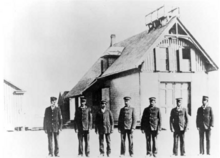
Keeper Richard Etheridge (on left) and the Pea Island Life-Saving coiffure in forepart of their station, circa 1896
Emblem of the U.S. Life-Saving Service
Pea Island Life-Saving Station was a life-saving station on Pea Island, on the Outer Banks of N Carolina. It was the first life-saving station in the country to have an all-black crew, and it was the first in the nation to have a black homo, Richard Etheridge, as commanding officer.[ane] On Baronial 3, 2012, the second of the Coast Guard's 154-foot Picket-Class Cutters, USCGC Richard Etheridge (WPC-1102), was commissioned in his honor.
Richard Etheridge, early history [edit]
Richard Etheridge was born a slave on January 16, 1842, the son and the belongings of John B. Etheridge, on the Outer Banks of North Carolina. Large plantations didn't exist in the Outer Banks; African Americans were relatively few and slavery express. During his early life, Richard Etheridge, similar most Outer Bankers, learned to work the sea, fishing, piloting boats, and combing the embankment for the refuse of wrecks. Even though it was illegal to practice so, his master also taught him to read and write.[2] [3]
After the outbreak of the American Civil War in April 1861, the Outer Banks were the site of one of the first Northern invasions, in February 1862. Full general Ambrose Burnside, the Marriage commander, employed black labor to build fortifications for his armies, and the island presently became a refugee camp for fugitive slaves. The Union eventually realized the potential that the active recruitment of Southern blacks offered their forces, not only by bolstering the Wedlock ranks but past simultaneously diminishing the opposition'south labor supply. Black troops began being enlisted by the summertime of 1863; Richard Etheridge joined on August 28 of that year.[four]
The 36th United States Colored Troops, in which Etheridge enlisted, spent much of its start year of active duty like most of the other black units in the Marriage Army—playing secondary roles. After express anti-guerrilla deportment in Northward Carolina, the soldiers of the 36th served every bit guards at the prisoner-of-war camp at Betoken Lookout, Maryland, occasionally raiding into neighboring Virginia for contraband appurtenances: supplies, horses, cattle, or slaves. Necessity somewhen allowed the 36th to play a more prominent role in the fight for liberty and union.[v] The 36th distinguished itself during the September 1864 Battle of New Market Heights, Virginia. During the fighting, the Union forces overran Lee's strong position and won an important victory on the road to take the Confederate upper-case letter at Richmond. Etheridge was promoted to sergeant two days afterward the battle.[half-dozen] While fighting on the front to finish slavery, Etheridge was also active in the struggle behind Matrimony lines to end the mistreatment of blacks. During his duty in Virginia in 1865, he and William Benson drafted the post-obit letter to Major General Oliver O. Howard, the Commissioner of the Freedmen'southward Bureau, protesting the mistreatment that blacks on Roanoke Isle were suffering at the easily of the occupying ground forces. "[T]he white soldiers break into our houses act every bit they please steal our chickens rob our gardens and if anyone defends their-Selves against them they are taken to the guardhouse for information technology, so our families have no protection when Mr. Streeter is here to protect them and volition non exercise it." Etheridge and Benson'south letter was not only a weep of grievance but was also a call for action. "Full general we the soldiers of the 36th U.South. Co Troops having families at Roanoke Island humbly petition you to favor us past removing Mr. Streeter the present Asst Supt at Roanoke Island under Captain James." Etheridge signed the alphabetic character, "on behalf of humanity."[7]
At the War's shut, Etheridge, now a Regimental Commissary Sergeant, and the black troops of the Army of the James were regrouped into the Ninth and Tenth Cavalry and sent to Texas. These units would become known as the "Buffalo Soldiers." Instances of abuse against black soldiers were rife in the menstruation immediately following the Ceremonious War. The men were due ten months back-pay, had had their rations cut in one-half, and were unruly over the continued reports of mistreatment that were coming from their families back home.[8]
Flawed rescue [edit]
In December 1866, Etheridge left the service at Brazos Santiago, Texas. He returned to the Outer Banks, where he married. Etheridge made his living angling and serving in the newly formed Life-Saving Service, first at Oregon Inlet in 1875, and then at Bodie Island.
In the early years, nepotism and political cronyism tainted many Life-Saving Service appointments. A serial of highly publicized maritime disasters off the N Carolina coast appeared to be leading to the annexation of the LSS into the Navy. In two months, 188 lives and more than a half 1000000 dollars in property was lost off the Outer Banks, within sight and with little or nonclerical assistance from the lifesavers on shore. The New York World reported, "It begins to be painfully clear that the terrible loss of Human being life … on the North Carolina declension … must be attributed straight to the inefficiency of the Life-Saving Service."[9] [10]
In 1879, the commander of the Pea Island station (called a "keeper") was a white man and he had a crew of both white and black men. A rescue effort in Nov 1879 was bungled, and the keeper and some of the crew were held responsible. The Revenue Cutter Service investigated the situation, fired the white keeper, and appointed in his identify Richard Etheridge, one of the best surfmen on the N Carolina coast, to serve every bit keeper.[11]
In order to address the result of inefficiency in the service, the best lifesavers would need to be put in charge of stations. Etheridge, one of simply eight African Americans in the entire Life-Saving Service, was promoted from the lowest ranking surfman at neighboring Bodie Island station to have over the incompetently run station at Pea Island. The LSS inspector, 1st LT Charles F. Shoemaker; despite warnings from locals, recommended Etheridge to the position, wrote: "[Etheridge] is 30 eight years of age, [of] strong robust physique, intelligent, and able to read and write sufficiently well to keep the periodical of a station. [He is] one of the best surfman on this office of the North Carolina coast".[12] The report concluded: "[I am] aware that no colored human holds the position of keeper in the Life-Saving Service, and still such as are surfmen are constitute to be among the all-time on the declension of Northward Carolina"[12] "I am fully convinced that the interests of the Life-Saving Service hither, in betoken of efficiency, will exist profoundly advanced past the appointment of this man to the Keepership of Station No. 17."[13] [14] [15]
First African-American crew [edit]
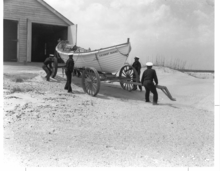
Pea Island USCG crewmen in 1942, showing lifeboat and boathouse
Richard Etheridge was the first African American to hold the rank of keeper of a life-saving station. When he was appointed, the white surfmen refused to serve under him. Thus, although other blackness men had served every bit surfmen at Pea Island and other stations, Pea Island Station came to be manned entirely by a black keeper and crew.[one] The other LSS stations, in N Carolina likewise as throughout the nation, would exist manned and run past whites.[16]
Five months subsequently Etheridge took charge, arsonists burnt the station to the ground.[17]
Rescue of the Eastward.S. Newman [edit]

Given the scrutiny he and his men were under, Etheridge knew that the slightest error could result in his or one of his crewmen's dismissal, that inadequacies, no matter how small, could result in the reinstatement of a white keeper and crew. So he ran the station with military ardor. All of his vigorous and exacting preparation paid off on the terrible nighttime of Oct 11, 1896 when the schooner Due east.Southward. Newman grounded south of the station.
The helm of the vessel had his married woman and three-year-old son on board when information technology was driven ashore during a hurricane on October 11, 1896. The storm was then bad that Keeper Etheridge had suspended beach patrols. Yet, from the station, a surfman, Theodore Meekins, thought he saw a distress point, and fired off a Coston flare to come across if there would be a response. Meekins and Etheridge watched carefully, then saw the schooner admit with a flare of her own.[18]
The Pea Isle coiffure with the aid of a mule team then pulled the beach cart with the rescue equipment and surfboat along the beach towards where the distress signal had been seen. Huge waves washing ashore made this especially difficult. Finally, when the crew arrived at the scene of the wreck, they found that the moving ridge conditions were so great that the surfboat could non be launched, nor could a breeches beacon be used because the beach was so inundated by waves that the anchor for the buoy line could not be placed in the sand. Two surfmen volunteered to swim out in the waves to attempt to reach the wreck. They somewhen did reach the schooner and managed to heave a line aboard. Nine times the surfmen went into the water and one past i the passengers and coiffure were all rescued, starting with the captain'south three-year-old son.[eleven] According to local lore, Meekins, who was reputedly the best swimmer of the group, fabricated every voyage out to the Newman.[19]
In the following days, the Newman's captain searched for and found the piece of the side that held the vessel's name and donated it to the crew as an offering of his cheers. For a century, this would exist the only award the Pea Island crew received for their efforts. The 1896 Pea Isle crew voted to give the wooden sideboard of the Newman to Theodore Meekins, the immature surfman who kickoff spotted the distress betoken and who swam out to the wreck several times during the rescue. (Fifth from left in photo.) Meekins took the board to his farm on Roanoke Island and nailed it to the top of his befouled. He served at Pea Island for 21 more years, until his death in 1917, when, while boating habitation on leave, a storm came upwards at Oregon Inlet, and he drowned trying to swim to shore.[20]
After years [edit]

Etheridge served as the keeper at Pea Island for 20 years. In January 1900, every bit Orville and Wilbur Wright were planning their voyage to Kitty Militarist to experiment with human flight, Etheridge, at the age of 58, fell ill and died at the station.[21] Pea Isle continued to be manned by an all-black crew through the 2nd Globe War. The station was decommissioned in 1947.[22] One of the last surviving surfmen to serve at the station, William Charles Bowser, died at age 91 on June 28, 2006. Herbert Collins, who served in the 1940s and put the locks on the station when it was closed, died Sunday, March 14, 2010. In 1996, the Declension Baby-sit awarded the Golden Life-Saving Medal posthumously to the keeper and crew of the Pea Island station for the rescue of the people of the E.S. Newman. Etheridge and his family are buried at the Pea Island Life Saving Station memorial on the grounds of the North Carolina Aquarium on Roanoke Isle.
Legacy [edit]
In 2010, the town of Manteo erected a bronze statue honoring Richard Etheridge.[23]
The Sentinel-grade cutter USCGCRichard Etheridge was named in his honor. She was commissioned on 3 August 2012 at her home port of Port Everglades, Florida.[24]
In 2021, the Coast Baby-sit Bears football squad representing the United states of america Coast Guard University dedicated their season's uniforms to Pea Island Life-Saving Station 17.[25]
See also [edit]
- Chicamacomico Life-Saving Station
- United States Life-Saving Service
Notes [edit]
- Citations
- ^ a b "African Americans in the United States Coast Baby-sit", United States Declension Guard. Accessed January 17, 2008. "Appointed Keeper of Pea Island Life-Saving Station on Jan 24, 1880, Richard Etheridge became the first African American keeper in the Service.... From the time of Etheridge's bold command in 1880, Pea Island was staffed past African Americans until the station was closed in 1947, afterwards which the expanse became a wildlife refuge.... The second all-African-American station (Pea Isle was the first) was organized at Tiana Embankment, New York."
- ^ Wright, pp 24-25
- ^ Wright, pp 43-47
- ^ Wright, pp l-55
- ^ Wright, pp 65-88
- ^ Wright, pp 97-105
- ^ Wright, pp 115-116
- ^ Wright, p 120
- ^ Wright, p 141
- ^ Wright, p 158
- ^ a b Shanks, p 131
- ^ a b Noble, p 52
- ^ Noble, p 53
- ^ Wright, p 162
- ^ Wright, p 166
- ^ Wright, pp 175-176
- ^ Wright, p 190
- ^ U.Due south. Life-Saving Service.org, "Wreck of the E.S. Newman" (accessed January 13, 2008)
- ^ Wright, David and David Zoby. "Ignoring Jim Crow: The Turbulent Engagement of Richard Etheridge and the Pea Island Lifesavers," The Journal of Negro History, 80/2, jump 1996
- ^ Wright and Zoby. "Ignoring Jim Crow"
- ^ Wright, p 297
- ^ Noble, p 51
- ^ "First African-American Life Saving Service station keeper honored with statue". Declension Baby-sit News. May 9, 2010. Retrieved Oct xi, 2019.
- ^ "Coast Baby-sit commissions second Fast Response Cutter at Port Everglades". Coast Guard News. August iv, 2012. Retrieved October eleven, 2019.
- ^ "CGA Football to Award Station 17 - Pea Isle", Declension Guard Bears, August 23, 2021. Accessed October 18, 2021. "Declension Guard will wear a special Station 17 uniform iv times this season on both Homecoming Games (Sept. 18 and Oct. second), on the road at Catholic on October. 16th as well as the Secretaries' Cup matchup confronting Merchant Marine on Nov. 13th."
- References cited
- Noble, Dennis Fifty.,That Other Might Live, The U.South. Life-Saving Service, 1878 – 1915, Naval Institute Printing, Annapolis, 1994, ISBN 1-55750-627-2
- Shanks, Ralph, Wick York and Lisa Shanks (Ed) U. South. Life-Saving Service: Heroes, Rescues and Compages of the Early Coast Guard, Costaño Books, Petaluma, CA, 1996, ISBN 0-930268-16-4
- Wright, David and David Zoby, Fire on the Beach: Recovering the Lost Story of Richard Etheridge and the Pea Island Lifesavers, Scribner, New York, 2001, ISBN 978-0684873046
External links [edit]
- U.Due south. Coast Baby-sit Historian's page on Pea Island Station, with photographs
- Slide-testify on Richard Etheridge, with photographs
- Pea Isle Life-saving Station: Rodanthe, North Carolina, Coast Guard Station #177: Celebrated Resources Report National Park Service
Source: https://en.wikipedia.org/wiki/Pea_Island_Life-Saving_Station
0 Response to "What did the pea islad surfmen do to save the passengers aboard the E.S. Newman"
Post a Comment